REPORT ON THE POLITICS OF PLUNDER AND STATE-SPONSORED EXPROPRIATION OF PROPERTY IN TÜRKİYE
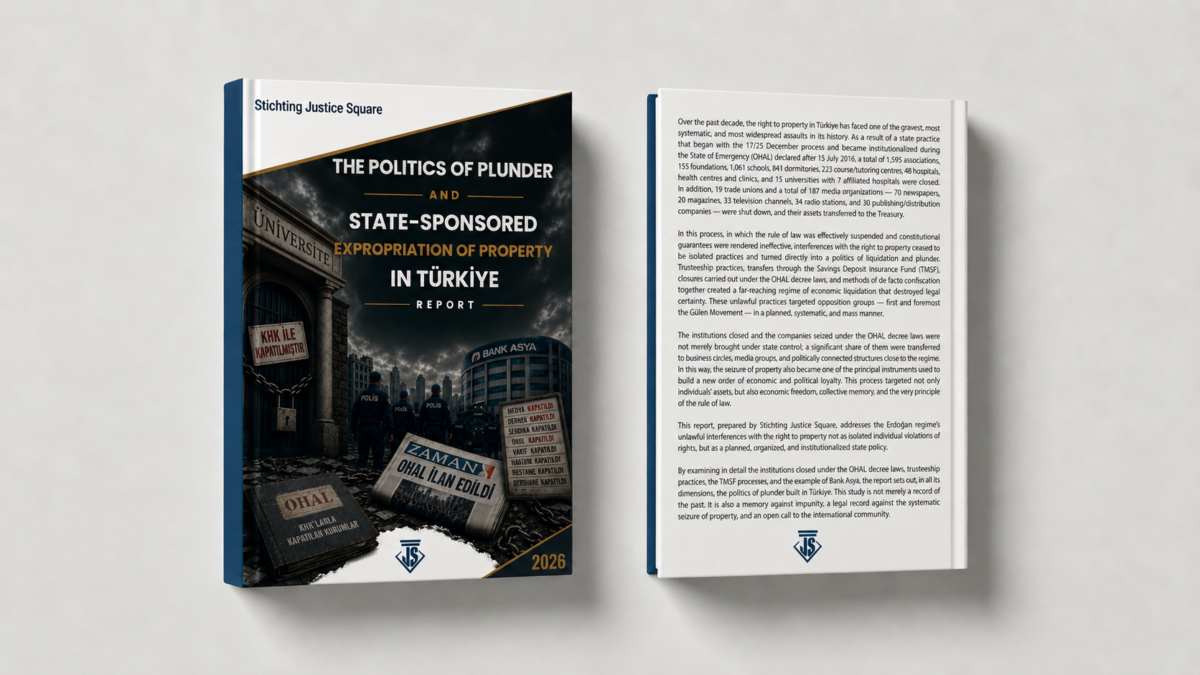
Report on the Politics of Plunder and State-Sponsored Expropriation of Property in Türkiye is the English-language edition of the report originally published in Turkish by Stichting Justice Square, "Türkiye'de Yağma Siyaseti ve Devlet Eliyle Mülkiyet Gaspı Raporu" (read the Turkish edition here).
This Report prepared by Stichting Justice Square, is a comprehensive human rights study examining the violations of property rights that have become systematic in Türkiye, particularly over the past decade. This report does not merely document isolated violations of rights. It reveals how interferences with the right to property have been institutionalized, turned into a political instrument, and transformed into a far-reaching regime of economic liquidation.
The right to property is one of the fundamental pillars of the modern rule-of-law state. Expressing an individual’s dominion over their material and non-material assets, this right is not merely a sphere of economic disposition; it is also the material foundation of human dignity, legal certainty, and individual freedom. For this reason, Article 1 of Protocol No. 1 to the European Convention on Human Rights and Article 35 of the Constitution of the Republic of Türkiye explicitly guarantee the right to property. In Türkiye, however, these guarantees were effectively suspended in the period that followed the 17/25 December 2013 bribery and corruption investigations, and, still more, during the State of Emergency (OHAL) declared after the dubious coup attempt of 15 July 2016. Rather than remaining a temporary security measure, OHAL was transformed into a wide-ranging mechanism of liquidation and property transfer. During this period, a large number of companies, schools, universities, hospitals, associations, foundations, and media organizations were closed, and assets worth hundreds of billions of Turkish lira were seized.
In this process, violations of the right to property were not isolated incidents; they were implemented as a centrally planned state practice. Seizures, the appointment of trustees, liquidations, and closures were carried out without any conviction, in a manner disproportionate to the criminal accusations involved, and productive of irreversible consequences. Practices defined in the case law of the European Court of Human Rights as “de facto confiscation” became an ordinary state practice in Türkiye. Violations of the right to property became institutionalized in particular during the state-of-emergency period; they were subsequently made permanent, legitimized through judicial decisions, and disseminated through administrative practices.
Rather than acting as the guardian of the right to property in this process, the judicial organs became the legitimizing element of the liquidation mechanism. Local courts, the Council of State, the Court of Cassation, and the Constitutional Court, through decisions that rendered the provisions of the Constitution and the European Convention on Human Rights ineffective, approved the closures, trustee appointments, and company transfers carried out by decree law, lending a legal appearance to practices that eliminated the very essence of the right to property.
Taking into account this grave picture with respect to the right to property in Türkiye, this report, prepared within Stichting Justice Square, examines in all its dimensions the practices of the politics of plunder and state-sponsored expropriation of property that have, particularly over the past decade, turned into a systematic state practice in Türkiye. This study sets out not isolated administrative acts, but a planned, organized, and institutionalized regime of property liquidation.
The report also situates the politics of plunder built in Türkiye within its historical continuity. State-sponsored expropriation of property is not solely a phenomenon of the recent period. The regulations concerning “abandoned property” relating to the assets of Armenians, the 1942 Wealth Tax, and the events of 6–7 September are historical examples of property being used as a political instrument. This historical background shows that current practices are not a rupture, but a continuation. The post-2016 period, however, differs from earlier periods in its scope and intensity, because in this period the Gülen Movement became the direct and sole target. What had until then been an exceptional practice was, in this period, transformed into general state practice.
During the OHAL process, thousands of schools, dormitories, tutoring centres, hospitals, universities, magazines, newspapers, television channels, and similar institutions and organizations alleged to be connected with the Gülen Movement were closed; hundreds of thousands of immovables were transferred to the Treasury; and trustees were appointed to hundreds of companies. In this context, under the OHAL decree laws, a total of 187 media organizations — comprising 1,595 associations, 155 foundations, 1,061 schools, 841 dormitories, 223 course/tutoring centres, 48 hospitals, health centres and clinics, 15 universities and 7 affiliated hospitals, 19 trade unions, 70 newspapers, 20 magazines, 33 television channels, 34 radio stations, and 30 publishing/distribution companies — were permanently closed and their assets transferred to the Treasury. In this process, thousands of companies were first seized and subsequently, through the Savings Deposit Insurance Fund (TMSF), appointed as trustee, transferred to businesspeople loyal to the regime and to their companies.
In this process, it was not only institutions that were targeted, but individuals as well. The salaries of hundreds of thousands of people dismissed from public office were cut, their retirement rights were obstructed, precautionary measures were placed on their bank accounts, and their passports were cancelled. People were systematically excluded from economic and social life. The politics of plunder, which began with the Erdoğan regime’s 17/25 December process and, during the OHAL period, turned into a state practice, is accordingly not merely an economic liquidation. It is collective punishment. It is the erasure of a community from economic, social, and public life. In other words, it is the excommunication, by the state as a whole, of a movement simply because it was in opposition.
One of the subjects on which the report particularly dwells is devoted to trusteeship practices and the role of the Savings Deposit Insurance Fund (TMSF). During the OHAL process, the practice of trusteeship ceased to be a temporary protective measure and was transformed into a mechanism of de facto confiscation. Trustees were appointed to many companies before the criminal proceedings against them had concluded; these companies were then collapsed, both managerially and economically. A significant portion of these companies was subsequently either liquidated or transferred to business circles close to the regime. The report draws attention to how the seized companies and economic resources were used to build a new political-economic order of loyalty. In this way, the seizure of property became not merely an economic interference, but also one of the instruments used to create a new regime elite.
One of the report’s dedicated sections is devoted to the example of Bank Asya. The transfer of Bank Asya — one of Türkiye’s largest participation banks — to TMSF, and the subsequent revocation of its operating licence, lay bare the financial dimension of the interferences with the right to property. The bank’s liquidation process is examined in detail from the standpoint of legal foreseeability, proportionality, and international banking standards. According to the report, the Bank Asya case is one of the symbolic examples of the reshaping of the economic system on the basis of political loyalty.
This report, prepared by Stichting Justice Square, analyses the politics of plunder and the expropriation of property not solely through legal norms, but within the framework of quantitative data, institutional examples, and international law. The purpose is not merely to place the violations on record. The purpose is to demonstrate the systematic nature of the violations of the right to property and to render institutionalized unlawfulness visible.
The report repeatedly notes that the Erdoğan regime turned the dubious 15 July coup attempt into an opportunity to dismantle the democratic parliamentary system and to build a “one-man” regime. Through the constitutional and legal amendments made to its institutional structure, the state ceased to be a “rule-of-law state” and was transformed into a “regime state.” Rather than the independence of powers and institutions, Türkiye evolved into an anti-democratic “one-man” regime characterized by the concentration and control of powers in a single hand. In other words, the institutional structure known as the State was transformed into the Erdoğan regime. As the natural consequence of this transformation, every element of the power apparatus adopted this policy. For this reason, describing the violations of rights and developments that occurred in Türkiye using the concepts of the “Turkish State” or the “Erdoğan Government” would not accurately express the transformation that has taken place in Türkiye; the report therefore specifically uses the concept of the “Erdoğan regime.”
The conclusion reached by this report, prepared within Stichting Justice Square, is clear: despite its normative guarantee, the right to property in Türkiye has been eroded in practice. The process that began with OHAL has turned into a permanent regime of property liquidation. This conclusion is reached as a result of the Erdoğan regime’s practices of the politics of plunder and the expropriation of property. Trusteeship practices, transfers through TMSF, closures by decree law, and policies of economic exclusion have become the constituent parts of the politics of plunder institutionalized by the Erdoğan regime.
Stichting Justice Square calls on the international human rights community, legal circles, academics, and democratic societies to build stronger solidarity against the systematic seizure of property and the unlawful state practices that have taken hold in Türkiye. It is our most fundamental hope that this report will contribute to the re-establishment of the principle of the rule of law in Türkiye, to the struggle against the culture of impunity, and to bringing an end to unlawful practices grounded in violations of fundamental rights.
Stichting Justice Square
Image courtesy of Moose2026 Photos via Pixelato